VWAP Explained: Why Institutions Trade Around Fair Value | Orovio Capital Group Blog
/Blog/VWAP Explained: Why Institutions Trade Around Fair Value
How the Market Really Moves: Sessions, Liquidity, and Participation
VWAP Explained: Why Institutions Trade Around Fair Value
Orovio Capital Group
January 22, 2026
VWAP is not a buy or sell signal. It defines fair value. Learn how institutions use VWAP to measure execution quality and assess whether price is trading at a premium or discount.
VWAP Explained: Why Institutions Trade Around Fair Value
Volume Weighted Average Price, commonly known as VWAP, is one of the most widely used benchmarks among institutional market participants. Unlike many popular technical indicators, VWAP is not designed to forecast price direction or generate trading signals.
Its purpose is far more practical and far more important: to define fair value.
For institutions that manage large amounts of capital, trading is not about catching tops or bottoms. It is about executing efficiently, minimizing market impact, and demonstrating disciplined participation. VWAP plays a central role in this process.
What Is VWAP?
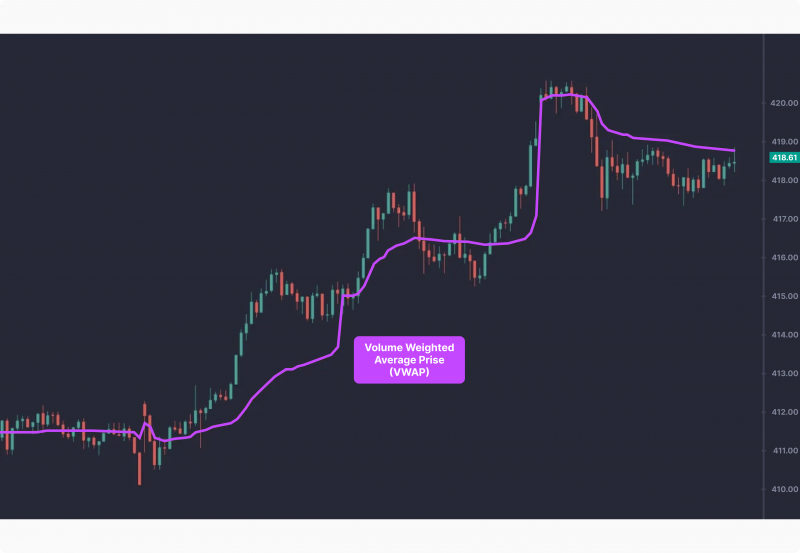
VWAP represents the average price traded during a specific session, weighted by volume.
This distinction is critical.
Unlike a simple moving average, VWAP assigns greater importance to prices where more trading activity occurred. High-volume transactions influence the calculation far more than low-volume ones. As a result, VWAP provides a realistic representation of where the market has actually conducted business.
This is why VWAP is trusted by institutions across equities, futures, and FX markets.
Why Institutions Care About VWAP
Institutions are judged on execution quality.
Funds, banks, and asset managers must be able to demonstrate that:
They did not chase price unnecessarily
They did not distort the market with poor timing
They achieved fills close to the market’s true value
VWAP provides a neutral benchmark for this evaluation.
If a buy order is executed below VWAP, it suggests efficient execution. If a sell order is executed above VWAP, the same logic applies.
VWAP is not about prediction. It is about accountability and efficiency.
VWAP as a Measure of Fair Value
VWAP helps participants determine whether price is trading at:
Fair value
A premium
A discount
General interpretation:
Price above VWAP → Market trading at a premium
Price below VWAP → Market trading at a discount
This information allows institutions to assess whether they are participating in alignment with market flow or entering trades at inefficient prices.
However, this does not mean institutions automatically sell above VWAP or buy below it.
That is a common retail misunderstanding.
VWAP Is Not a Signal Generator
One of the most frequent mistakes retail traders make is treating VWAP like:
A moving average crossover
Static support or resistance
A mechanical entry trigger
Institutions do none of these things.
VWAP is a contextual anchor, not a trading signal.
It helps answer questions such as:
Am I paying too much for liquidity?
Am I selling into weakness?
Is price accepted away from fair value or rotating back to it?
VWAP informs decision-making. It does not replace it.
How Institutions Use VWAP in Practice
Rather than reacting to VWAP touches, institutions focus on price behavior relative to VWAP.
Key behaviors include:
Acceptance above VWAP
Rejection from VWAP
Rotation around VWAP
Each behavior tells a different story about participation and intent.
For example:
Strong trends often hold above or below VWAP with minimal rotation
Balanced markets frequently oscillate around VWAP
Failed attempts to reclaim VWAP can signal weakening participation
VWAP becomes meaningful through interaction, not contact.
The Importance of Session-Based VWAP
VWAP resets with each trading session, which adds another layer of insight.
Different sessions often serve different functions in the market:
Asian Session VWAP Often reflects balance, accumulation, and low volatility participation.
London Session VWAP Frequently reveals directional intent and institutional commitment.
New York Session VWAP Can highlight continuation, distribution, or countertrend participation.
By analyzing VWAP on a session-by-session basis, traders gain insight into who is active and how committed they are.
VWAP and Market Conditions
Price behavior around VWAP often reflects the overall condition of the market.
Trending markets Tend to remain above or below VWAP with acceptance.
Ranging or choppy markets Often rotate around VWAP repeatedly.
Transition phases May show sharp rejection or failure to hold VWAP.
This makes VWAP especially useful for distinguishing between trend continuation and balance.
Why Retail Traders Often Misuse VWAP
Retail traders frequently reduce VWAP to a single line on a chart.
Common mistakes include:
Treating VWAP as static support or resistance
Entering trades simply because price touched VWAP
Ignoring volume and session context
This oversimplification removes the very element that makes VWAP valuable: its institutional intent.
VWAP is not meant to be traded mechanically. It is meant to be interpreted.
Combining VWAP With Liquidity and Structure
VWAP becomes significantly more powerful when combined with:
Liquidity analysis
Market structure
Session timing
For example:
Price reclaiming VWAP after taking liquidity may signal renewed participation
Failure to hold VWAP after a liquidity grab may indicate distribution
VWAP alignment with higher-timeframe bias improves execution confidence
Institutions never rely on VWAP alone. It is one component within a broader framework.
Acceptance, Rejection, and Rotation
Professional traders focus on three core behaviors around VWAP:
Acceptance Price holds above or below VWAP, indicating agreement on value.
Rejection Price tests VWAP and fails, suggesting inefficiency or lack of participation.
Rotation Price moves back and forth around VWAP, signaling balance.
Understanding these behaviors is far more valuable than trying to predict direction.
What VWAP Does — and Does Not — Tell You
VWAP does not tell traders:
Where the market will go
When to enter or exit
Whether price will reverse or continue
VWAP does tell traders:
Whether participation is efficient
Whether price is extended from fair value
How institutions are interacting with the market
This distinction is what separates professional use from retail misuse.
Final Thoughts: Why VWAP Matters
VWAP is indispensable not because it predicts price, but because it explains value.
When traders stop asking:
Is VWAP support or resistance?
And start asking:
Is price being accepted away from fair value?
Their understanding of market behavior changes dramatically.
VWAP aligns traders with institutional execution logic, not retail speculation.
That is why institutions trade around fair value. And that is why VWAP remains one of the most important tools in professional trading.
About Orovio Capital Group
A quantitative trading firm delivering institutional-grade trades powered by proprietary models and data-driven analytics, replicated in real time across client accounts.